Mini T. rex Skeleton Fetches $47.3 Million at New York Auction
A rare Nanotyrannus skeleton nicknamed "Jodi" sold to an anonymous buyer for far more than Sotheby's expected, becoming the second most expensive dinosaur fossil ever sold.
By Marta Greco ·
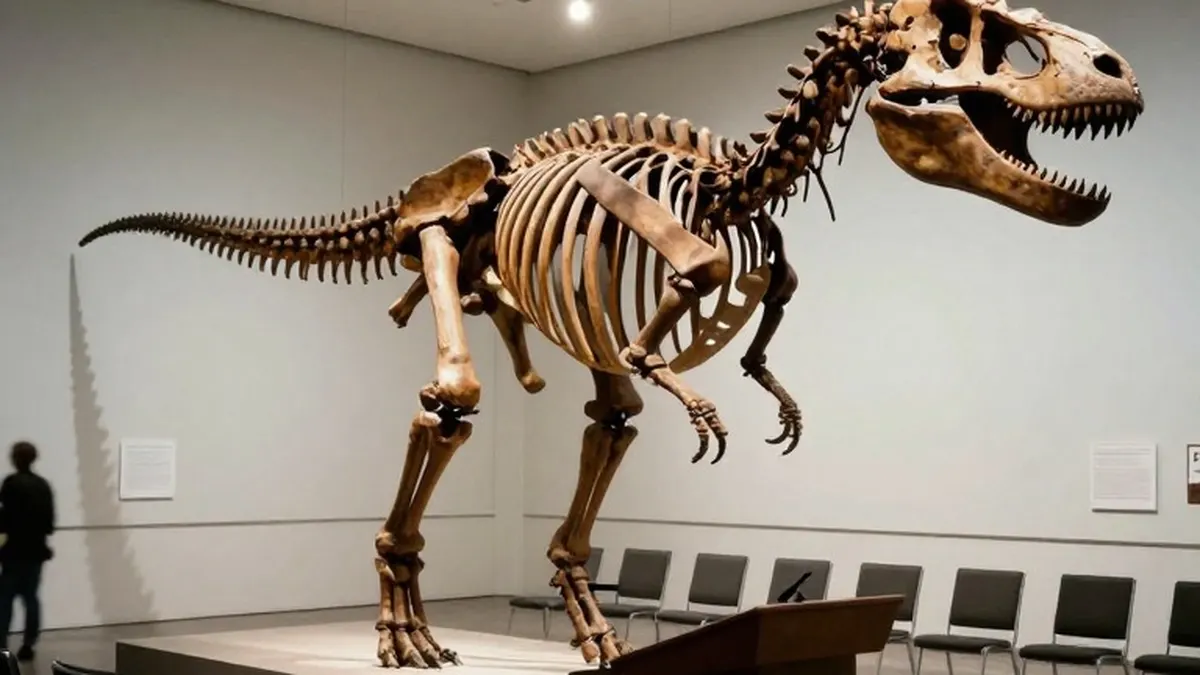
A fossil skeleton of a dinosaur resembling a smaller T. rex has become one of the most expensive ever sold. The Nanotyrannus specimen, nicknamed "Jodi," went for $47.3 million at a Sotheby's auction in New York City on Tuesday.
Sotheby's had estimated the skeleton would sell for between $6 million and $9 million. The final price was several times higher, and the buyer has chosen to stay anonymous for now. According to the auction house, that buyer outbid five other prospective purchasers who competed online and by phone during a live sale lasting about 12 minutes.
The result places "Jodi" second on the list of priciest dinosaur skeletons ever sold. The record belongs to a T. rex fossil called "Gus," which brought in $50.1 million at Sotheby's this summer.
Nanotyrannus lived alongside Tyrannosaurus rex during the Cretaceous period, roughly 67 million years ago. It grew to about half the length of an adult T. rex. Compared with its better-known relative, it had longer forelimbs, bigger hand claws and thinner, blade-like teeth.
The specimen stands 6.5 feet (2 meters) tall and stretches nearly 20 feet (6 meters) long. It is considered almost 70% complete, and only three such skeletons are known to exist. It had been displayed at Sotheby's upper Manhattan headquarters since earlier this month.
The dinosaur takes its name from Jodi Pierson, a Montana rancher who found it on her land in 2019. A team of professional fossil hunters later worked to locate and excavate it, an effort that was the focus of the 2020 Discovery Channel documentary series "Dino Hunters."
Sotheby's thanked that team in a statement. "Their commitment to understanding and preserving this remarkable specimen has helped bring us to this moment, a testament to the fact that we can all make major contributions to science," said Cassandra Hatton, the auction house's head of science and natural history.
Not everyone welcomes such sales, however. Some scientists have objected to fossils of this importance being sold privately, arguing that "Jodi" and similar finds belong in museums or other institutions where researchers can study them and the public can see them.
The sale also follows a shift in scientific understanding. For decades, experts were unsure whether Nanotyrannus was its own type of dinosaur or simply a juvenile T. rex. Research published last year concluded that it is a distinct genus.
Source: ABC News
More News · National news · Report a business · Got a Story?